Wednesday, December 29, 2010

Welcome 2011!


With a new year upon us, it is a time for both reflection and looking forward. I wanted to take a moment to thank my family, friends, and supporters for their interest in me and my art work in 2010. I am looking forward to hitting the studio in January and have some exciting new ideas that include photography and oil paints.

I wish you and yours, a very Happy Holiday and all the best in the coming new year!

Peace
Lisa Tornack

Friday, November 19, 2010

Mark Your Calendar!


Please join me December 18-19th at Calgary's Market Collective. Come down to the former home of Ant Hill Fabrics in Kensington and get into the Christmas spirit! Shop and meet local artists, photographers, creators, and other hipster types. This independent art market showcases the talents of local artists and featured musicians, as well as a holiday photo booth!

Market Collective is happening
Saturday December 18th / 10:00 am - 6:00 pm
Sunday December 19th / 11:00 am - 5:00 pm

Ant Hill Building
148 10th Street NW (Kensington)

http://www.ffwdweekly.com/article/news-views/news/pave-over-paradise-put-up-a-parking-lot-6651/
www.marketcollective.ca

Monday, November 1, 2010

What is Creativity?


What is creativity; what does it mean to be creative?
Most people think of creativity as solely a creative pursuit i.e painting or drawing. No doubt creativity can include those activities, but I think creativity can be applied to many areas, even to something as linear as business for example. Creativity or creative problem solving is the ability to make choices or decisions on the fly; in direct response to unplanned events or problems. It is also the ability to think outside of what has been done to find answers, resolutions, or new ways of doing things. This type of problem solving is done consistently when creating a work of art. The artist is constantly making decisions or problem solving to work out compositional concerns; what colour to place next to one another as well as where to place objects on the picture plane. The artist makes these decisions in direct response to unplanned events. Artists are able to make snap decisions for what is best for the artwork or project. This may result in changes, alteration, or elimination of key elements of the original idea. I often describe this to students as doing what is best for the piece, which may mean letting go of their favorite elements in order to create the strongest artwork possible. Often times I hear from the untrained eye, when viewing a piece of art that appears simple or is abstract by nature "I could do it". In the act of copying or mimicking an artwork the I could do that statement may hold true, but I challenge those voices to start from the beginning of the creative process with blank page and create their own simple or abstracted work. This of course is far more difficult. Like many activities when done well, appear to be easy to execute.

Like any talent some people are naturals, but I believe everyone can develop their creative side. Individuals should go in with realistic expectations when beginning their creative pursuits. Whether taking a painting class or learning to play the guitar, practice makes perfect. The more time you spend doing an activity the better you will become at it. Word to the wise, it is unrealistic to think after one session of art classes you will have a master piece to hang above your sofa. Take your time, build on your skill set, and try to enjoy the creative process. Very interesting things happen when you learn to let go, this holds true in both life and art.

If you have ever had a interest in a pottery class or if you have always wanted to paint at the lake, I encourage you to go for it. You may find a life long hobby or at least tap into creative problem solving skills.

Tuesday, October 19, 2010

Infinity and Other Personal Symbols


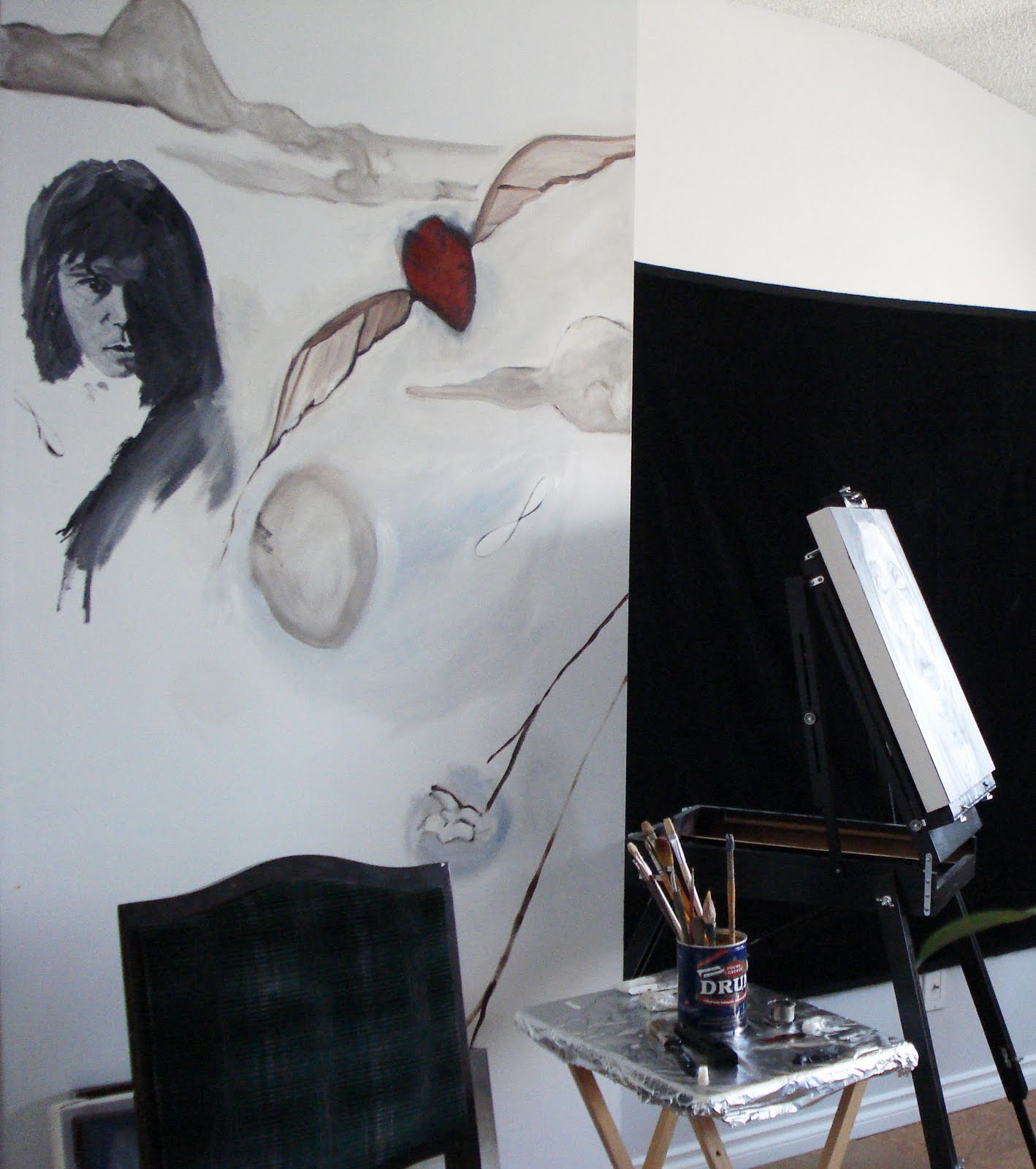
As promised here is an image of the collaborative piece Eric Nylen and myself have been working on in the studio. The mural is a "work in progress" featuring a youthful Neil Young, winged hearts, and falling stylized cherry blossoms. The imagery in this mural is pulled from our own personal symbols. As I have mentioned before personal symbols are images that hold meaning to the creator of them. I often use a number of symbols in my artwork. Falling leaves, cherry blossoms, infinity signs, and the color red are symbols I use often in my paintings. The leaves and cherry blossoms are symbolic of inner peace and tranquility. This imagery juxtaposed against messy aggressive text represents an inner dialog. I have also begun using infinity symbols in my paintings, looping the shape over and over the horizon line. The definition of infinity is something without limits: limitless time, space, or distance; the symbol itself is unbroken and never ending. I use this symbol in tandem with leaves and blossoms to represent ever lasting peace; beginning with peace of mind and in the larger context harmony with all of mankind. The colour red is seen in almost every one of my paintings; like blood pumping from the heart, red is a symbol of energy and life force. The use of symbols in my artwork communicates to the viewer through visual language, themes I am exploring in both my artwork and my life.

Tuesday, September 21, 2010

The Importance of Seeing Art


Above: Caixa Forum, Madrid, Spain.

In my life, I have been very fortunate to see a number of master pieces up close and personal, one might ask why is it important to see art in the flesh? The main reason to view artwork personally is for the experience of seeing the world through different eyes. Aristotle once said, "the aim of art is to represent not the outward appearance of things, but their inward significance". The experience of seeing artwork can be up lifting, inspiring, and often thought provoking. For artists and art enthusiasts you can also uncover techniques by viewing work in person; often times there are many subtleties within the piece to be discovered. Nuances in colour, as well as brush strokes are often lost when a painting is reproduced, in a book for instance. Also, I am often surprised by the scale of many iconic works. A prime example of this is Leonardo Divinci’s Mona Lisa (also known as La Gioconda) because of the paintings notoriety, one assumes the piece is larger than it really is. In life the Mona Lisa is actually quite small, with dimensions of 20 7/8 x 30". On the opposite end of the spectrum Picasso’s Guernica, is shockingly large and it's massive scale is both awe inspiring and extremely moving in person.

In the list below I have outlined some museums I have been fortunate enough to visit and would highly recommend. Get out there and see art, on your next vacation or in your own community at local museums, galleries, or artist run centres.

Lisa's Picks
Musée de l'Orangerie-
is an art gallery of impressionist and post-impressionist paintings located on the Place de la Concorde in Paris. The high light of this museum are the massive panels of Monet’s water lilies that were inspired by his own garden. http://www.musee-orangerie.fr/

Museo Reina Sofia
- If you are ever in Madrid, Museo Reina Sofia features Picasso’s Guernica. The massive painting is a must see. This enormous piece is very moving and was painted in response to the bombing of Guernica, in the Basque Country of Spain.

Caixa Forum- This relatively new facility in the heart of Madrid, features rotating post modern art exhibitions and the dynamic architecture is amazing. Designed by Herzog & de Meuron the exterior of the building in collaboration with French botanist Patrick Blanc integrates living plants juxtaposed against a rusted sheet metal exterior (pictured above).

National Gallery of Canada- Closer to home, if you are in the Ottawa area check out our own national treasures. The National Gallery of Canada features an excellent collection from artists from the Group of Seven.

Musee D’Orsay- Located in Paris, the museum holds mainly French art including paintings, sculptures, furniture, and photography, Musee d’Orsay is best known for its extensive collection of impressionist and post-impressionist masterpieces (the largest in the world) by such painters such as Monet, Manet, Degas, Renoir, Cézanne, Seurat, Gauguin and Van Gogh.
Musée d'Orsay: Overview


Above Picasso's, Guernica, oil on canvas, 776 x 349 cm, 1937

Sunday, September 19, 2010

My Time in Farrera


This blog entry is a continuation of my painting diaries. As I have mentioned before in 2008, I was fortunate enough to work as an artist in residence in Spain. While working at the Centre D’Art i Natura I encountered some of the most challenging days of my life both personally and artistically. The art centre is located in a remote village high a top the Spanish Pyrenees. There was not too much in this tiny village; no store, no café, or public transport. My days began with a self catered breakfast and the ritual of logging on to my computer selecting music, pouring fresh water and if weather permitted, opening the large glass patio doors of my studio. The studio was beautiful, featuring a long wall of exposed rock wall. The space was unheated, with a tap for water and amazingly there was also a small natural spring that jutted out of the base of rocks. The opposite wall of the studio, there were glass patio doors that opened on to a large deck. This all glass wall allowed for an abundance of natural light. After working in such a grand space, the Spanish studio is the template for the studio I hope to build one day.

I signed up for a seven week residency at the art centre. The days were long without interruption, with very little contact with others. In all honesty after the first week I wasn’t sure if I had it in me. I was intensely lonely at the beginning. After all the preparation for the trip; working hard, going away parties, as well as visiting with family and friends, the quiet and stillness of the mountain was almost unsettling. To battle the isolation, all I could do was work and that is what I did. I worked fast and furious, taking breaks only to eat and take walks. When I wanted time away from the studio, I would hike down the mountain paths, my main routes were two to three hour hikes. Even with large breaks during the day, I still worked any where from 6- 8 hours in the studio. Dinner was served at 9 pm, many days it was the one time of day I would speak to someone. As the art centre was very quiet in the spring with few residents, mainly visiting on weekends from Barcelona. Without the distractions of regular life; coffee with friends, maintaining a household, and running errands, time was in abundance.

The result of this experience, although at times difficult was extremely rewarding. I emerged from my time on the mountain confident and armed with an entire body of new work. The intense studio time allowed me to complete a series of works I began back in Canada. Before the residency I had the seeds of a new idea; the integration of text into my work. The time afforded to me during the residency allowed for me to develop this new idea completely, but by the end of the seven weeks I was completely tapped out creativity.

My time in Farrera also taught me a few things about discipline and I honed my work ethic. Before this experience I didn’t know I could work for long periods in the studio. During this time I developed rhythms in my studio practice. I worked on multiple pieces; while one piece was drying another was ready to go. I would sketch write, and work on unrelated side projects when I needed a change of pace. This way of working that I took away from the experience and are the methods use in my studio to this day.

Wednesday, August 25, 2010

Back to the Studio

This summer I have had the opportunity to spend a good chuck of time painting. I have been fortunate to complete some new works and have had the opportunity to experiment with new materials. One material I have begun working with are oil sticks. For those of you that have not worked with the material before, oil sticks are basically an artist’s oil paint in stick form wrapped with paper. This material has allowed for a different way of working. I am able to apply colors directly on to the canvas as easily as if I was drawing instrument. Unlike oil pastels, oil sticks are much larger, softer, and can be easily combined with traditional oil paints. I began experimenting with the sticks as a way to integrate words into my canvas pieces; as a way of creating thin, fluid lines. Although I have completed many paintings with text, most of these work were on paper. The challenge I have been facing, is how to create thin precise lines of letters on the rough tooth of canvas.

Another method have been experimenting with this summer, is something I learned from my ceramic studies, a technique called sgraffito. Sgraffito comes from the Italian word meaning to scratch. I begin by applying one paint color, then allow it to dry this usually takes 4-5 days. Then when dry I paint a second color over top of the first. While wet, almost immediately after application I will use the end of my paint brush and write words by scratching away the top layer of wet paint away, in order to reveal the dry color beneath.

I am looking forwarding to displaying this new work at the Marquee Room this fall. Please mark your calendars for Thursday, October 7, 2010 for the opening reception!